"We no longer have a vision for the future!"
Paradox: On the one hand, most people are doing well. But more and more people have the feeling: The future is getting worse. What's wrong with us? That's what the Berliner Zeitung asked psychologist and market researcher Stephan Grünewald in January 2018.
The interview appeared in the Berliner Zeitung on January 7, 2018.
Mr. Grünewald, how are Germans feeling at the start of the new year?
We are in a paradoxical situation. On the one hand, most people are doing well. But more and more people have the feeling: The future is getting worse. The crises that surround us are spilling into our peaceful Shire. Our basic problem is that we have no vision for our future. This leads to an almost fearful desire to stabilize the here and now for as long as possible.
Why isn't there more coming?
We Germans have settled into an all-round care system - pampered by Mother Merkel - and have concluded a kind of standstill agreement with those in power. According to the motto: "You take care of our prosperity, and we'll submit to your dictum that there is no alternative." Now we are reaching a point where the whole thing is tipping over.
In our stasis, we feel increasingly powerless. Many people are asking, "If we keep this up, can we face terror, the disintegration of Europe, or guys like Erdogan or Trump?" We are experiencing a time of awakening. Germans feel: We have to become active in order to get out of our powerlessness.
The explanation for Merkel fatigue?
This is an expression of a desire for emancipation. But the citizens are torn. They continue to value Merkel as a stabilizer. She stands for the preservation of the Shire, is a kind of predator tamer for the Putins, Erdogans and Trumps of this world.
What role did the refugee crisis play?
That was the first shake of confidence. On the one hand, because of the loss of control. On the other hand, because of the question: Who does Mother Merkel actually love more? Who gets the attention, the money, the social housing - her own children or the children of others? All responsibility is shifted to the mother. You're fine out of it instead of taking a look yourself: How is the world changing? And what do I have to do myself to understand it and help shape it?
Is that where the anger you see in many in-depth interviews comes from?
The anger is fed by the feeling of being powerless in the face of a complex world that can hardly be understood anymore. In addition, parts of the population have the feeling that the elites look down on them because they still drive diesel, eat meat, smoke, watch lower-class TV, and are afraid of immigration.
There is no longer the basic social solidarity of the 1970s, when the elites fought for the "little guy. Instead, the elites turn away in pique and give people the feeling that they are no longer capable of satisfying them. This is especially true of the Greens.
What do you expect from elites?
That they get out of this moral conceit, give people esteem. For all its prosperity, many of those we surveyed also feel that Germany is a neglected country with dilapidated schools, broken highways, no-go areas and justice problems, because many hardly benefit from prosperity. One wishes that the elites would get out of their cloud cuckoo land and address these everyday issues.
How stable is the web of values that holds our society together?
It is porous. In the state of all-round care, values also dwindle. We are not grateful for the fact that we are well off, that we can live safely and express our opinions freely. Everything is taken for granted. Sometimes it's almost helpful when a crisis comes along. That shows again how important certain values are.
They describe us as an exhausted company. But we never had so much free time.
That's because we can suffer the exhaustion basically quite well. Because in the hamster wheel, we block out our fears, problems and contradictions. During longer breaks, restlessness strikes us again and drives us back to mindless activity.
We need courage for leisure
To avoid questions that we should be asking ourselves?
Exhaustion distracts us and also gives us a sense of satisfaction. I call it pride in exhaustion, as opposed to the pride in work of days gone by. Today, you rush from one appointment to another, checking hundreds of emails. Many work processes are fricasseed, so that in the evening you don't even know what you've actually done. Only exhaustion proves that the day was productive.
The more exhausted we are, the more proud we can be. This is a vicious circle that can lead toward burnout. But as long as we are exhausted, we are not inventive. So long we lack the visions and the ideas for our own future and the future of the country.
And the politicians?
Some of the politicians are also exhausted. Just think of the Jamaica exploratory rounds, the biting into details and the constant polls that drive politicians before them. Sometimes I wish I could return to the tranquility of the Bonn Republic, where you could have a beer with your political opponents in peace. It is only in such a decelerated state of mind that good ideas are born.
The solution for us?
We need the courage to take time off. But by that I don't mean a wellness vacation - that only ensures that I can soon be even more exhausted - but rather unscheduled time in which we can give our thoughts free rein and pursue our dreams. In this way, we can find out what we want and where it pushes us. Nothing new can emerge on the hamster wheel.
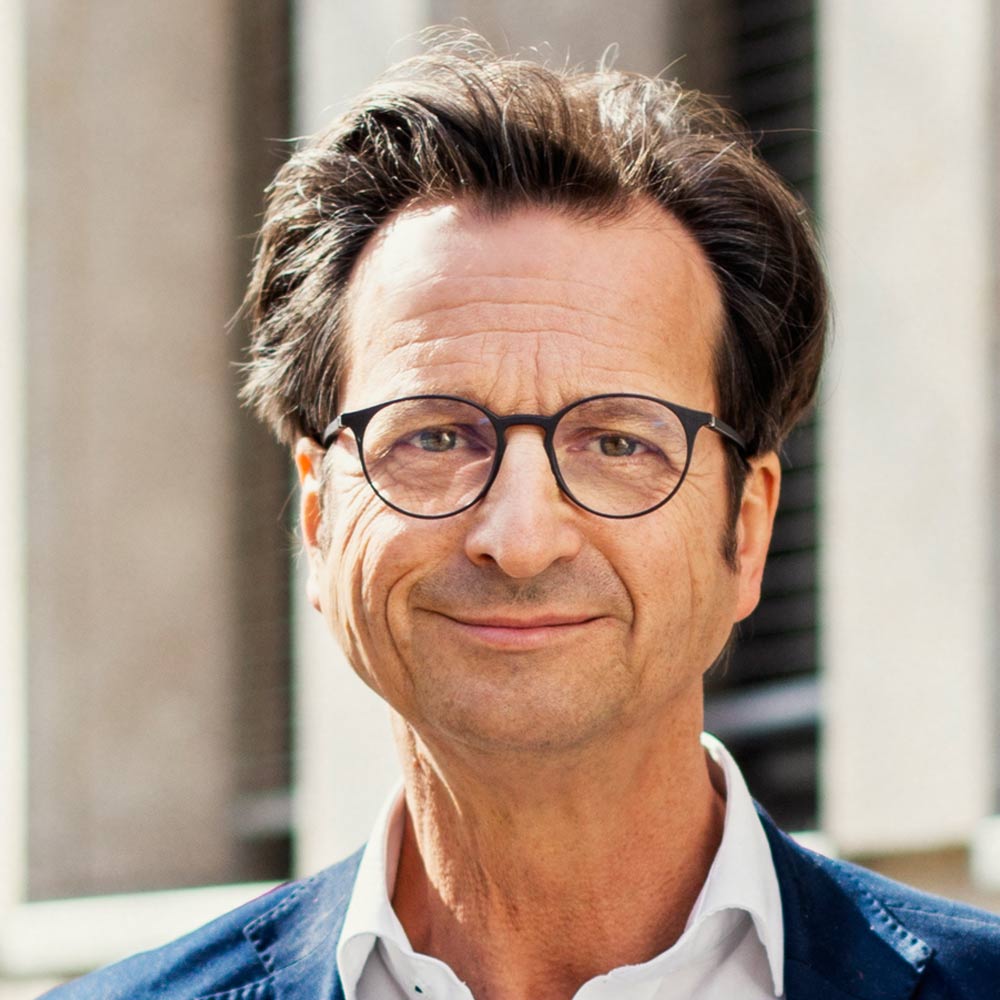
Cologne-based psychologist Stephan Grünewald is the founder of the market and media research institute rheingold. Grünewald became a bestselling author with his books "Deutschland auf der Couch" (2006) and "Die erschöpfte Gesellschaft" (2013) as well as "Wie tickt Deutschland" (2019).
Phone: +49 221-466 828 0
E-mail: gruenewald@rheingold-online.de