Suddenly, our old life lies before us in a thousand pieces. Stephan Grünewald, one of the country's best-known psychologists, sees great risks in piecing things together - but also the magic of new beginnings.
The interview with Stephan Grünewald appeared in Stern on April 25, 2020.
Mr. Grünewald, before the crisis, you described in studies and books how Germans perceive their country: as a paradise of prosperity, as a shire endangered from the outside by the dark land of horrors, by globalization, foreigners, refugees, terror. Now the threat of a deadly virus is added. What is the current state of the nation's soul?
We experience an admirable power of toleration of the people. They are willing to endure a lot. They keep still. They wait. But we also know that this time of endurance is under tremendous inner tension. People notice that in themselves, too. When will it break out of me? At the moment, the majority still believes that this collective fate welds everyone together, but the big worry is that this state will tip over. That also makes it so difficult for politicians to find the right tone. It's a fine line between snapping and snapping.
As a psychologist, what behavior surprised you during the crisis?
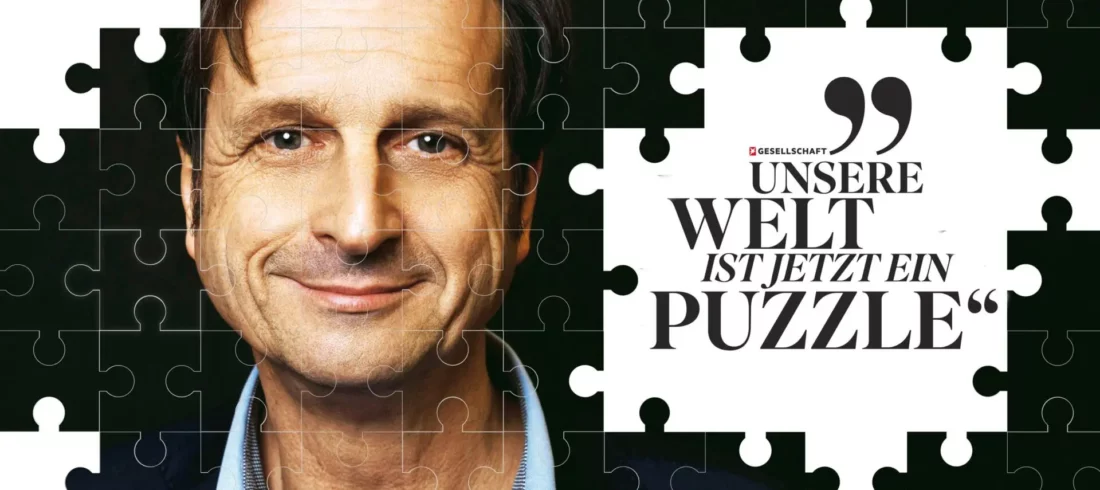
Jigsaw puzzles are suddenly very popular.
My wife also sat at the dinner table this weekend with the half-finished Statue of Liberty made of 1000 pieces.
Psychologically, this is very interesting. Our world is also shattered into a thousand pieces with Corona. With the puzzle, we restore order very slowly and piece by piece. How does your wife go about doing the puzzle?
First she makes the frame, then the dark parts, then the blue and white for the sky. What does the psychologist say about this strategy?
The outer framework gives us a foothold, as a guideline or guardrail. It is also typical that she has set herself stage goals. Step by step. This can also be applied to major politics.
You're part of NRW Minister President Armin Laschet's twelve-member Corona Council. Did you also advise him to take small steps?
Yes, I took up the analogy of the jigsaw puzzle. Give people a new color or slogan every two to three weeks.
What is the best amount of time we can hold out until the next goal?
Two to three weeks is good, six weeks is the maximum.
What makes you think that?
40 days, about six weeks, is the old plague measure. This is how long arriving ships had to lie in the harbor in Venice during the plague period before the crew was allowed to go ashore. That is a period of time that we humans can still easily keep track of.
You gain your phenomena and findings about us through several hours of depth psychological interviews. There have been thousands of men and women on the couch at rheingold. How can you work at all in corona times?
We changed the methodology to virtual in-depth interviews overnight five weeks ago. However, the psychologist still talks to people for two hours. One disadvantage is that we now experience the respondent less, but in return we get insights into their private lives that you rarely get otherwise. We have also experienced how happy people are that a two-hour window opens up in their isolation. They can also sort out their everyday life again in the conversation. At the moment, we experience our subjects as more grateful than ever before.
Do you personally dread the Corona world we are now learning to live in?
In the crisis, so many moments of fear work together. I fear for the health of my family. I worry about my parents, who are in their mid-80s. My daughter has Down syndrome, she is 20. In Cologne, a 49-year-old woman with Down syndrome died of Covid-19. Then I worry about our institute. We still have a good order situation, but the requests are getting fewer. Third, the worry, how do we get our daily life stabilized? My daughter lost her job in the laundry of a youth hostel. She had to give up her shared apartment with another Down girl and two students who went to live with her parents. And then the question occupies me: How does our society endure the crisis?
This is already the third major crisis in this young century. In the 2008 financial crisis, we feared for our money. In the refugee crisis of 2015, many feared for their safety. Now it's a matter of life and death.
The Corona pandemic is seriously different from all other crises.
What do you mean?
Our entire everyday life is turned upside down. Everything that has given our lives structure, confirmation, compensation and comfort so far suddenly breaks away dramatically. The crises that preceded it were events that caused far fewer deep shocks. In the financial crisis, Merkel and her finance minister stood broad-legged in front of the threat and signaled: We will protect you. In the case of refugees, it was the upper limits and the Turkey pact that led to calm. What we are experiencing now is different: this crisis has an immediate impact.
Because everyone is directly affected?
Even more, every fellow human being is suddenly a changing figure. Is he a friendly helper who supports and protects me? Or an aggressor who, without knowing it, carries the virus and brings me the infection? This is a completely different situation. It has an existential drama for people. The core of this crisis is a tremendous experience of powerlessness.
How do you explain the hoarding purchases?
People wanted to use it to take back control of their lives.
Toilet paper for crisis defense, seriously?
Those who buy quantities of toilet paper demonstrate that they are business-minded even in times of crisis. We did a study for a sanitaryware manufacturer. One type of consumer in particular caught our eye, we called him the show-off. He prides himself on being able to successfully go to the bathroom three to four times a day. He usually does this when he feels like he is losing control of his daily life. He literally shit on the circumstances and got things under control that way.
In our neighborhood, a paint fan is the most exchanged object. People paint their walls.
Good example. DIY, tinkering or gardening is also about keeping or taking back control of your life. The hardware store is the place for personal upgrading. Nowhere else do people have such empowerment experiences. Hammers, drills, pliers provide a great deal of effective power.
Swiss economist Thomas Straubhaar says: "People come out of the crisis physically and psychologically weakened. That weakens the economy and society as a whole." Is he right?
I see the danger, but not in such a sweeping way. The crisis is experienced differently. Some are in a deceleration. They don't have as much to do and turn to the analog richness of life. They cook, they have relationship conversations, they go for walks and enjoy nature. This leads to recovery and grounding.
Others continue to toil under tougher conditions. After all, part of the economy continued to run.
During the crisis, many were confronted with digital compression without precedent. For them, important expansion joints are breaking away from everyday life. I'll take myself as an example: a few days ago, I had a presentation at a company. That would normally have been a day's work: three hours to get there by train, three hours at the customer's, three hours back. Now that's been digitally shortened to a two-hour meeting. The remaining seven hours were filled with other meetings. That eliminates the commute. Some people will come out of the crisis even more exhausted, while others have had a vacation from the hamster wheel.
How important was it that we were never locked up, walking and jogging remained allowed?
I am glad that there were no rigorous curfews. People were left with their little escapes. The German soul can be described as a double soul. We are bureaucratic, formalistic, the TÜV of the world. We can only put up with ourselves in this controlled way by being travel world champions at the same time. The little getaway becomes a substitute for Tuscany and Mallorca.
The chancellor has praised her people several times. Almost all of them are abiding by the new rules. Are we Germans smart or too obedient to the authorities?
In many people in this country, disciplinarity and a longing for firm control are more pronounced than in other mentalities. This was an advantage during the crisis. We compare favorably with other countries in terms of mortality rates.
But the dispute over Corona rules is getting sharper.
After a phase of collective brake activism, we have arrived at the polarization phase. Now the doubters are speaking out. Now it is important to promote understanding. One example: The collective restrictions were willingly borne by the people because they were the same for everyone. Everyone had to make the same sacrifice. The transition is now very sensitive. Individual and differentiated relaxations can quickly be experienced as a departure from solidarity. This can give rise to new envy structures, jealousies, sibling rivalries. If we choose specific relaxations for sectors or groups, then this must be explained precisely. Everyone must have the feeling that the easing does not benefit individual interests, but the whole.
What is the best way to do that? What did you recommend in the Corona Council?
People need clear instructions for action in the relaxation. Firstly, so that they don't fall into the old rut. But also so that the feeling of helplessness doesn't spread. That's why it's smart to think about masks or a tracking app that can be used to trace infection chains.
Which stores would you have been the first to reopen?
Hairdressers.
Why?
In lockdown, in social deprivation, many people are afraid of going wild. And these fears of going wild are particularly stoked when people notice that their hairstyle is slipping away, that there is only wild growth. Going to the barber becomes a civilizing act that distinguishes the citizen from the barbarian. That's why hairdressers have an important function, they are everyday therapists for people, they wash our heads.
What have you observed in politicians facing an unprecedented crisis?
I experienced Mr. Laschet, who surprised me in a positive way. He took a lot of time. We sat together virtually four times for two hours. He moderated cleverly. If we stay with the puzzle picture, he was able to bring the positions into an overall structure at the end.
Did you feel the power struggle with Markus Söder?
Not for me. My impression was that the joint decision was more important to him than personal gain. I found that very reassuring.
The virus macabrely fits the propaganda of the right: It came from abroad. From the land of horrors. Globalization and open borders accelerated its spread. What reactions do you expect in the Shire: more fear, more xenophobia, more isolationism? Less openness to the world?
We are already in a phase where there are two tendencies that worry me. We have drastically narrowed our focus on life as a result of the crisis. At the moment, people have no global perspective, no European perspective and no German perspective. They look, if at all, at their state, their city or their district. This narrowing of the field of vision can play into the hands of right-wing forces.
And the second trend that worries you?
We are already experiencing calls for a Söder plus. For a charismatic leader who regulates even more clearly. More and more people, even beyond the AfD clientele, are taking a skeptical view of democracy with its laborious and lengthy processes, and they are flirting with authoritarian politicians who wave through projects in record time. There is a secret fascination that can be strengthened by this crisis.
So the grand coalition is merely hovering at an interim high in current polls?
Yes, the dark clouds are gathering. You can see this in media usage. At the beginning of the crisis, people spent much longer and more time than usual reading quality newspapers and magazines. That's already waning again. Now, daydream bubbles on the Internet are once again very popular. Conspiracy theories are proliferating. Restlessness is growing. The danger is that after the crisis, many will try to compensate for their experiences of powerlessness by looking for new scapegoats. People who reify the danger.
Are there examples of this from previous crises?
I did my first psychological examination a few months after Chernobyl. A few weeks after the reactor catastrophe, which was also connected with an invisible threat, we suddenly had a big debate about asylum seekers. People were able to show control again and cool their chins.
On the other hand, we also see great solidarity. People show consideration, help each other. Will any of this remain?
Unity in society arises when there is a promising vision or a common threat situation, i.e. a negative vision. The threat from Corona will probably remain for a long time, so will cohesion.
One consequence of the crisis will be rapid digitalization. Supermarkets without cashiers, autonomous trucks without drivers, factories without people...
This is the one reality after Corona that we will experience.
That is, there is another?
We have made the experience that it also works with less. With less consumption, with fewer social contacts. Unthinkable before Corona. We had the feeling of digital omnipotence. With a flick of the wrist, we could take over and control the world on our smartphones, even find out about sex and relationships. Now puzzles and Corona are teaching us new humility. Progress is small-scale and laborious. We also learn: every part, no matter how small, is important to the whole. We must not overlook or lose any part, otherwise the whole will no longer work.
You sound optimistic?
We now have the chance to readjust how we want to live, how we want to do business, how society should function. We experience, for better or for worse, what we are capable of and what we can well do without. We feel, as after fasting, what we have a real appetite for again. This is the great opportunity that we now have to experience an expansion of our repertoire in the social sphere, in the economy and in the shaping of everyday life, which makes it possible for us to shape the future differently.
How do you know that?
This is how it is described to us in in-depth interviews. The existential drama of the crisis is also experienced as a revitalization. We are out of the eternal repetition loop that has characterized society for the last ten years.
After the financial crisis, it was also said: Globalization is at an end. People are coming to their senses. Then all prices and curves went rapidly up again. Perhaps post-Corona capitalism will be even more brutal, even more man-eating.
Unlike after the financial crisis, I see a great opportunity for us to find a more productive development based on the new experience. After the financial crisis, we saw two coping mechanisms. People celebrated a consumer carnival. The other impulse was, we plunge into a contemplative bustle. Now we've been forced into reflective inactivity. And the breeding ground for good ideas is boredom. New things grow when we pause and purpose-free spaces open up. It is a well-known fact that necessity can also be inventive.
What specific advice do you have for people whose breath is taken away by crisis anxiety?
Anything that helps us experience ourselves as active people helps: gardening, cooking, pottery, crafts, cleaning, puzzles.
What do you do?
I want to re-read - besides research - "The Plague" by Camus. Parables of fate in literature can be very relieving.
The interview was conducted by Norbert Höfler.
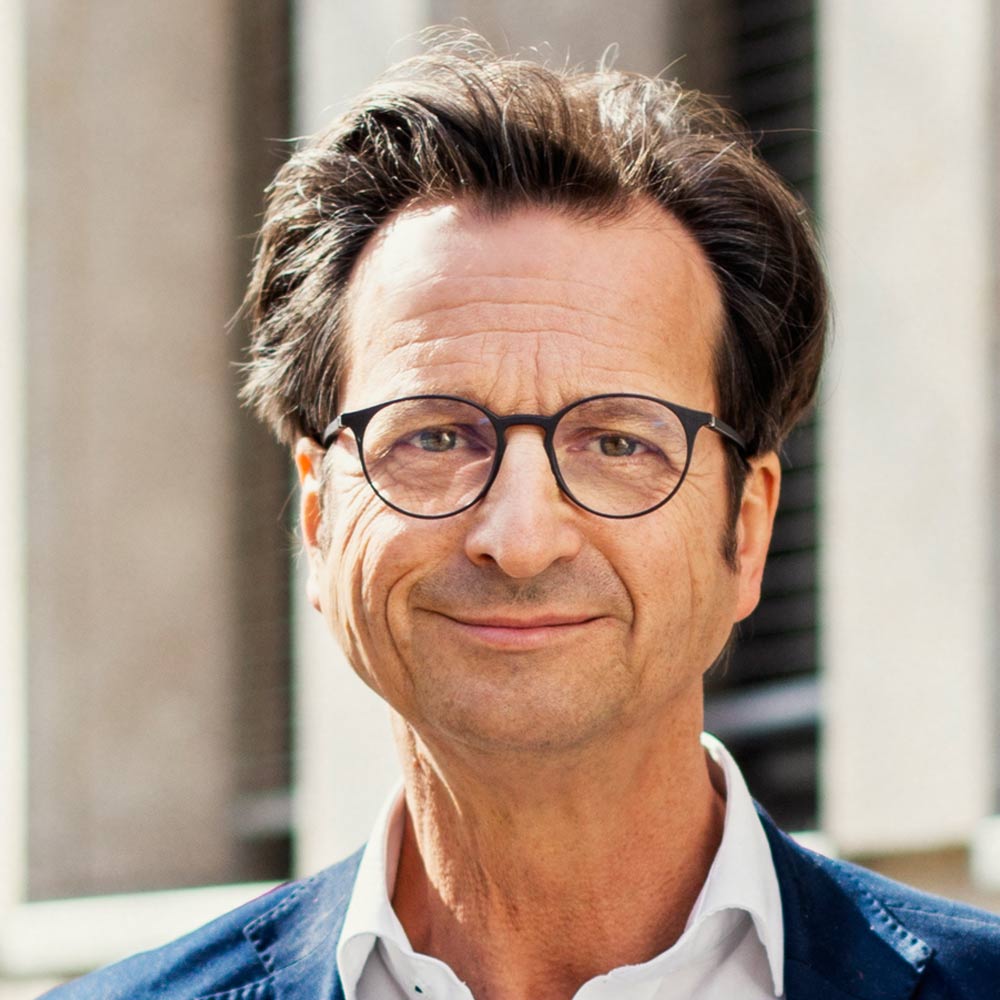
Cologne-based psychologist Stephan Grünewald is the founder of the market and media research institute rheingold. Grünewald became a bestselling author with his books "Deutschland auf der Couch" (2006) and "Die erschöpfte Gesellschaft" (2013) as well as "Wie tickt Deutschland" (2019).
Phone: +49 221-466 828 0
E-mail: gruenewald@rheingold-online.de