
The Federal Republic is celebrating its 70th birthday. What is the state of mind of the jubilarian? Psychologist Stephan Grünewald detects calm and composure - but also a dangerous simmering
The interview with Stephan Grünewald appeared on Zeit Online on May 16, 2019.
Mr. Grünewald, next week the Federal Republic of Germany will be 70 years old. You have been researching the state of mind of Germans in your institute for years. If the Federal Republic were a person and came to you, what would be your first impression?
Superficially: a calm and serene person. But if you take a closer look, you notice a very great inner restlessness and agitation. This is articulated in an inner conflict, a smoldering mistrust of the elites and a growing intolerance.
How do you explain this restlessness?
The Federal Republic of Germany is actually one of the last paradises, a kind of wonderful Shire with low unemployment, economic stability, good health care. But this shire is threatened by many dangers, whether it's climate change, terrorism, digitalization, globalization, the migration issue. These dangers are shifted outside as if into a bad bank, into the gray country. This splitting up of the world leads to the fact that in the future only the bursting in of the horror is seen and not the chance for transformation.
The roots of many psychological problems go back a long way, which is why psychologists like to dig into their clients' childhoods. What was the childhood of the Federal Republic like?
The founding years after the collapse were years in which, on the one hand, a tremendous depression weighed on the countryside, but at the same time there was an exhilarating liberation. Free of all rules and role models, one could start anew. From this grew a great confidence in one's own creative power
. The first major caesura came in 1968, when the repressed came into consciousness with force: only now did people really come to terms with the old, partly National Socialist structures. At the age of 19, the Federal Republic was thus about emancipation, liberation from the dictates of the fathers and liberalization at all levels.
The typical age for a rebellion?
Yes, rebellion is generally a matter for the young. This quasi-pubescent movement has had a strong influence on the republic, for example through the women's movement or the environmental movement. That probably wouldn't have happened without 68.
In the years that followed, the Federal Republic developed into a fairly stable adult: successful, striving, well-adjusted.
This was a basic line well into the 1980s, flanked by system competition. Self-confidence was also drawn from the certainty that one embodied the better system than the East.
The GDR was a kind of outcast twin of the Federal Republic. What does it actually mean when such a close relative is practically split off for decades?
In the case of the Federal Republic, this division ultimately had a stabilizing effect. In the GDR, one could see what happens when one abandons oneself to a dictatorship and defines one's entire life according to the dictates of the party
. As a result, liveliness and creativity die out. That's why the GDR was always a kind of negative identity surrogate for the Federal Republic: I'm not that, and I never want to be that.
How would you describe the identity of the Federal Republic?
It is not an identity that is at rest and rooted in itself like that of France with its centralist culture of enjoyment or that of the U.S. with the American Dream. The defining momentum in Germany is always one of doubt, a restless search for oneself. In the Federal Republic, two ways of dealing with this restlessness developed. On the one hand, it was banished by relying on bureaucracy, paragraphs, DIN standards, formal rules to which everyone must adhere. On the other hand, however, and this has contributed a great deal to the Republic's success, the country has managed to transform unrest into creativity, into poetry and lateral thinking, into engineering, inventions and patents. This creative side had been shut down in the GDR.
So what was it like when this mismatched twin suddenly showed up on the doorstep in his early 40s?
Reunification was something intoxicating at first. The contradictions of life literally dissolved, and everything suddenly seemed possible. The East suddenly experienced luxury, freedom to travel, democracy. The West, in turn, was in a potent donor position, like the rich relative who could invite, who was admired and, when he then went to the East, rose directly to the boss role. So it was initially a win-win situation for both sides.
When did it tip?
When the East realized that it was basically not about a productive confrontation between two systems, but that one system was being put over the other. The history of the East, in which there were also social achievements and a certain everyday art, was leveled, as it were. A kind of revolution had started in the East. And after 1989, people had managed to cope with the complete collapse of their own life system, which was an enormous achievement. This was neither seen nor appreciated by the West. That's why there is still a feeling in many parts of the East today that they are not appreciated enough.
What impact did the end of the East-West conflict have on the Republic as a whole?
A subtle but momentous revolution of meaning set in. A cool and fun world without ideology and political programs seemed possible. In the nineties, everything was relativized and ironized, it became more colorful and upbeat. But over time, de-ideologization plunged the republic into unleashed arbitrariness and a tremendous crisis of orientation. The inner compass was lost, and the old external certainties also broke away. The U.S., the uncle from the West, no longer watches over us, the European family is in danger of drifting apart, China as a competing economic power threatens our prosperity.
How did the Federal Republic respond to this crisis of orientation?
Ultimately, with a kind of regression. Political responsibility has been handed over to a good mother, Angela Merkel, who has led the country for over 13 years. Her typical hand position, the rhombus, acts as a symbol of the Shire's demarcation from the outside world: I'll protect you from the dangers, you're safe in here. That was the pact. When so many refugees came to Germany in 2015, when the rhombus was symbolically opened, it seemed to many as if the mother had betrayed her own children. That explains some of the anger that Merkel faced and ultimately heralded the end of her chancellorship.
What does it mean when that mother leaves?
This offers the chance for new political maturity. But at the same time, the inner instability and forlornness can once again become more apparent. It also promotes the triumph of fake news: lies make the world much easier to put right, they have a stronger power to provide orientation than truth, which is always differentiated, complex and shaded. But where public spirit is replaced by lies, conspiracy theories or private ideas of salvation, cohesion disappears. Society increasingly disintegrates into groups that consider their own values and beliefs to be the only true ones: I am right, you are wrong. It is an infantile way of arguing.
So at 70, the Federal Republic is back at a childlike stage of development?
In any case, she is facing a second maturity test. I call this the time of awakening. From my point of view, two scenarios are possible: One is the rude awakening. It would basically be a relapse into old-age radicalism, a return to totemism. We are once again looking for a strong leader who says à la "America first": We are the navel of the world, we are giving up our civilization in favor of a tribal culture in which German or European unity breaks up into many hostile tribes, but with the promise that we are once again powerful, that we can rule through and steer
giant projects. I see the danger that after 70 years, the Federal Republic will return to the kind of obsessive fundamentalism from which it got away after 1945.
And the second scenario?
That would not be the radicalism of old age, but the wisdom of old age. It also means finding your way back
to a mature culture of debate: you take a position, but you are prepared to engage in an eye-to-eye debate with those who think differently. This is exhausting, but it also opens up
a mental space. Without it, you get stuck in the stale. But there can be no "business as usual" in view of the global upheavals. We need utopias for the future.
At 70, is the Federal Republic now in its most difficult phase yet?
One is always inclined to glorify the current phase as the most difficult. Now the big question is
: Is the Federal Republic drifting into radical fundamentalism? Or will it manage to reinvent itself
through productive dispute?
To what extent have Germans internalized the history of the Republic's development?
Basically, what I have said about the nature of the Federal Republic is based on in-depth interviews
with many individuals. And I see the restlessness and agitation of the Republic
already reflected in the majority of Germans. Of course, you will always find people who are completely at rest within themselves. But most Germans are indeed driven by restlessness. Some implement it by constantly traveling the world, the next banish it by devoting themselves to the formalisms of bureaucracy, still others translate restlessness into delusions of grandeur. It is all the more important to transform restlessness into creative energy, which is what the Germans have succeeded in doing time and again.
And how are today's young people growing into this country?
For the majority of these young people, it feels like paradise on the one hand, because so much is possible, especially compared to other European countries with high youth unemployment. On the other hand, however, the young people also feel the curse of paradise: When so much is provided, and prosperity and success are already there, the pressure of expectation becomes enormously high. Many have the feeling of failing if they don't become an influencer with hundreds of thousands of followers or a start-up millionaire. This compulsion to be perfect is paralyzing.
Do you nevertheless see movements among the young to shape the republic differently in the future?
Quite, the current student strikes are an example of this. Climate change is becoming one of the megatopics of this generation. Young people are realizing that they have to take action, because otherwise the old people will betray their future. At the moment, in my view, the "Fridays for Future" are still taking place in a far too well-behaved manner
. The cheerful agreement between students, parents and teachers then merely creates a symbiosis of concern. But I also see the potential for radical demands to be made, for a generational conflict to arise that gnaws at the comfort consensus. The country will need this polarizing dispute to move forward.
The interview was conducted by Merlind Theile.
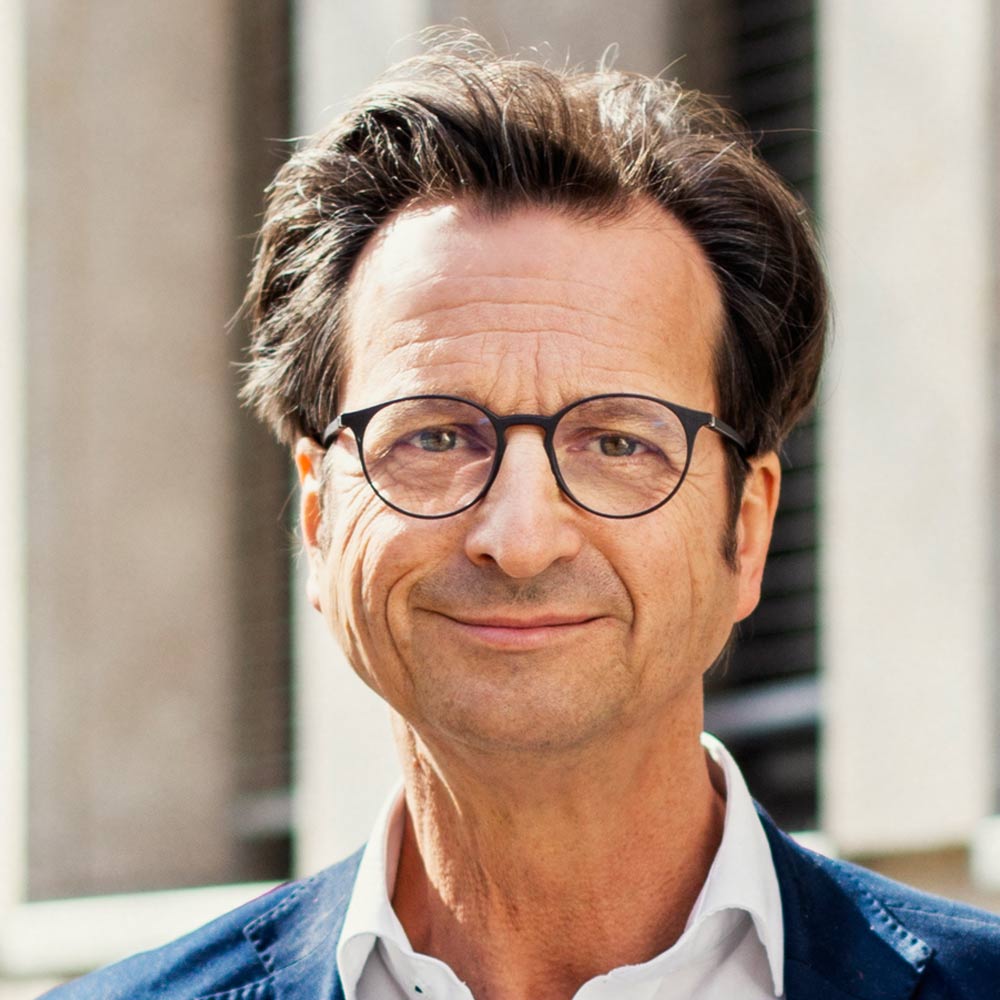
Cologne-based psychologist Stephan Grünewald is the founder of the market and media research institute rheingold. Grünewald became a bestselling author with his books "Deutschland auf der Couch" (2006) and "Die erschöpfte Gesellschaft" (2013) as well as "Wie tickt Deutschland" (2019).
Phone: +49 221-466 828 0
E-mail: gruenewald@rheingold-online.de