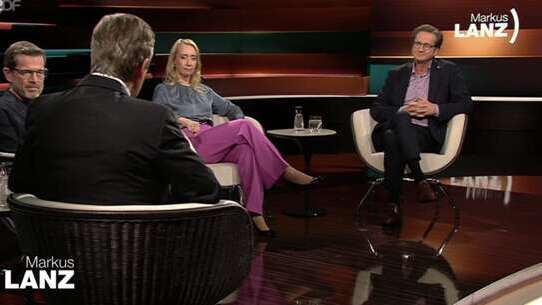
It is an evening about crisis acrobatics, solidarity, and the art of transforming crisis energy into a new beginning. At the beginning of the program, Markus Lanz introduces rheingold founder Stephan Grünewald—and has very appreciative words for his new book "Wir Krisenakrobaten" (We Crisis Acrobats), in which he discusses the rheingold approach and rheingold studies—especially social and cultural studies:
Stephan Grünewald, who has just published a book that is well worth reading because parts of it are truly original: Wir Krisenakrobaten(We Crisis Acrobats). In the book, he describes what is really going on inside Germans.
This statement set the tone for the discussion: it was about the state of mind of the country, about how we talk to each other, argue and shape the future – not only politically, but also psychologically.
A forum for social debate
The program was designed to provide a broad perspective. Journalist Melanie Amann reported on her visits to elite US universities and described an atmosphere of caution in which open debate is increasingly being replaced by strategies of self-preservation. Susanne Kaiser, reporting from Buenos Aires for the Konrad Adenauer Foundation, described how Argentina under President Milei is experiencing remarkable economic stabilization despite social upheaval—albeit at the cost of social hardship. Karl-Theodor zu Guttenberg, on the other hand, focused on the question of how democratic parties in Germany should deal with the growth of the AfD: with clear demarcation, but without knee-jerk reactions.
need to belong
These three perspectives opened up a space for resonance in which the topics of freedom of expression, political polarization, and social pressures intertwined. On this basis, Stephan Grünewald was able to identify the psychological components of these developments and reveal how they are reflected in people's experiences: in withdrawal, in silence, in the need for support and belonging.
A central motif is the retreat into private life. Many people feel that the multitude of global challenges—war, migration, the consequences of climate change—are virtually uncontrollable. This leads to a sense of powerlessness and a retreat from the public sphere into familiar and controllable areas of life. In the short term, this has a stabilizing effect, but in the long term, it creates "pent-up kinetic energy, " according to Grünewald: the vague certainty that change is actually necessary, but we are unable to take action.
Crisis of connectedness
This is linked to the crisis of connectedness described by Grünewald. Discussions have shown that people avoid contacts in which they would be confronted with opposing views. Instead, closed resonance spaces emerge—Grünewald calls this "silo solidarity." People remain connected, but only with those who think similarly anyway. This weakens a society's ability to engage in productive debate.
Stifled expression in young people
Young people in particular are feeling the effects of this development. In digital spaces, where visibility and evaluation are closely intertwined, the fear of immediate criticism often leads to self-censorship. On Lanz's show, Grünewald talks about "pent-up expression": people no longer express their opinions for fear that they could be vulnerable to attack.
Against this backdrop, the question of a contemporary culture of debate is becoming increasingly important. Grünewald reminds us that good debate used to be a natural part of relationships: people argued fiercely, but remained connected. We need places and rituals that allow us to openly exchange views—and then continue to sit together at the table.
Politically, this also means that a few, easily understandable priorities must be set. Change becomes feasible when people feel empowered to act. Grünewald cites the first energy-saving winter as an example of how a collective effort could have been marked and reinforced.
Willingness to engage in dialogue with uncertain voters
In the discussion about how to deal with the AfD, he emphasized the need for a clear distinction: decisive dissociation from extremist positions— and at the same time an openness to dialogue with unsettled voters. Exclusion alone reinforces the feeling of being lost. Dialogue creates opportunities to make belonging tangible again.
The evening painted a picture that was neither dramatized nor embellished: the social energy is there. It is waiting to be harnessed, directed, and used collectively.
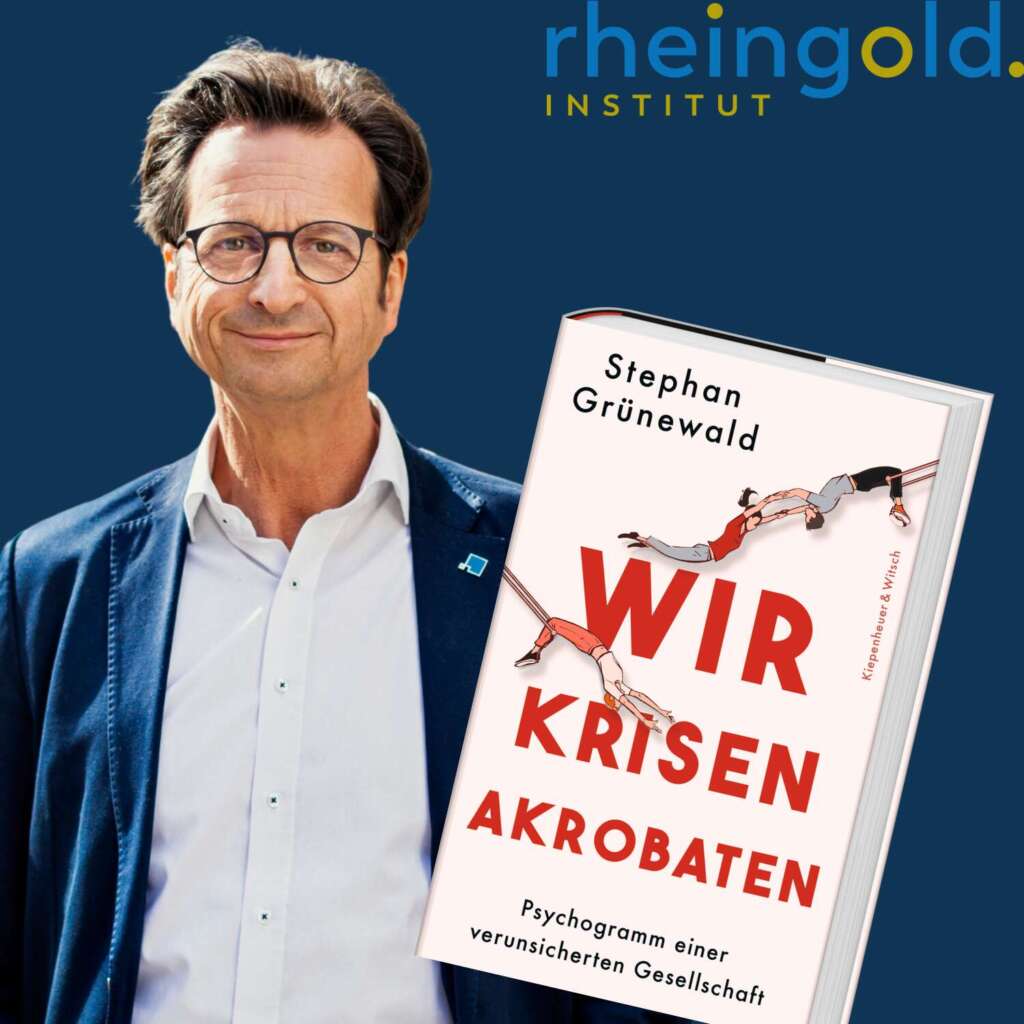
Book recommendation:
Stephan Grünewald: Wir Krisenakrobaten (We Crisis Acrobats). Psychogram of an insecure society.
Kiepenheuer & Witsch, €24.00.
Based on several thousand two-hour in-depth interviews, Stephan Grünewald paints a psychological picture of the current mood.
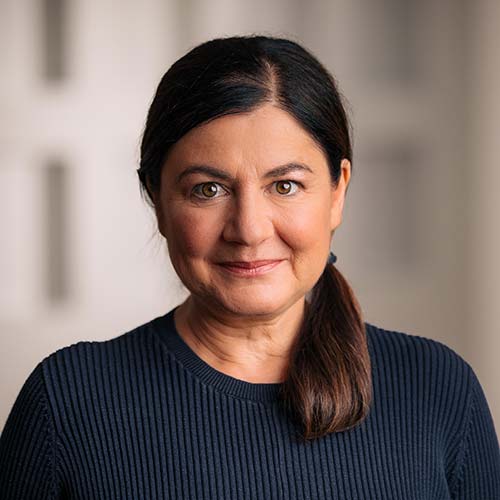
Ismene Poulakos is a journalist and storytelling expert. At rheingold, she is responsible for all publishing activities such as PR studies and the rheingold webinars.
Phone: +49 221-466 828 0
E-mail: poulakos@rheingold-online.de