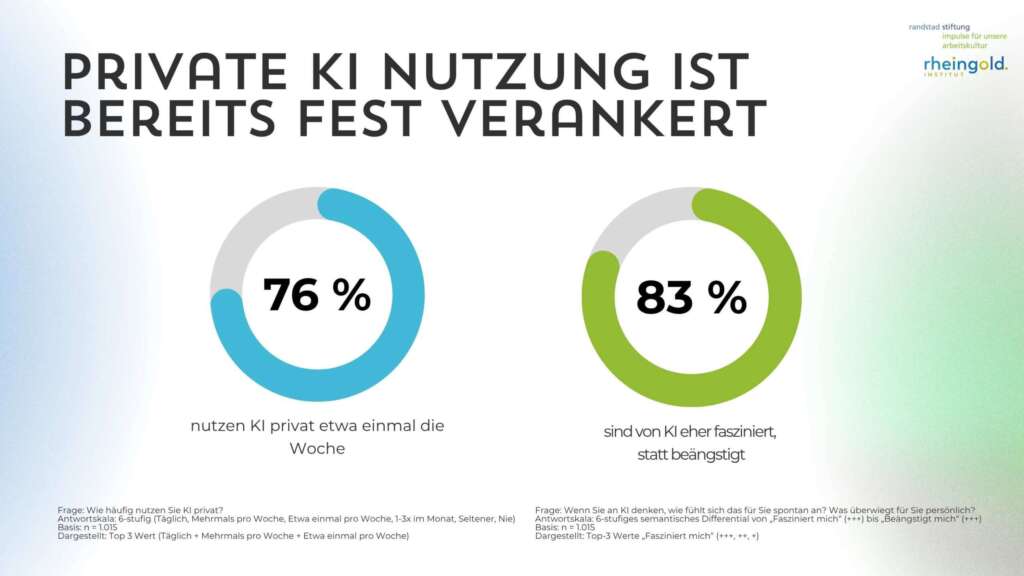
Artificial intelligence (AI) in the world of work is both a promise and a threat for many employees and therefore a psychological stress test. AI inspires and at the same time awakens the unconscious fear of replaceability and loss of control." 76% already use it regularly in their private lives, 78% see new opportunities for the world of work. However, parallel to the fascination, people are seething. Employees are suppressing their fears of being devalued or even replaced by AI.
AI as a stress test for the future of work
The study "AI and the future of work: stress test for leadership and collaboration" by the rheingold Institute for the randstad Foundation shows that companies are relying on the introduction of technological AI, but are underestimating uncertainty, defensiveness and displacement. "Those who ignore the psychological dimension risk disruption in teams, loss of trust and blockages in the transformation process," says Johannes Dorn, Managing Director of the rheingold Institute. "Right now, companies need to understand that it's not just about technology and efficiency gains, but also about identity, self-worth and the culture of collaboration."
Click here for the recording of the presentation of the study
Fear of replaceability in the work context
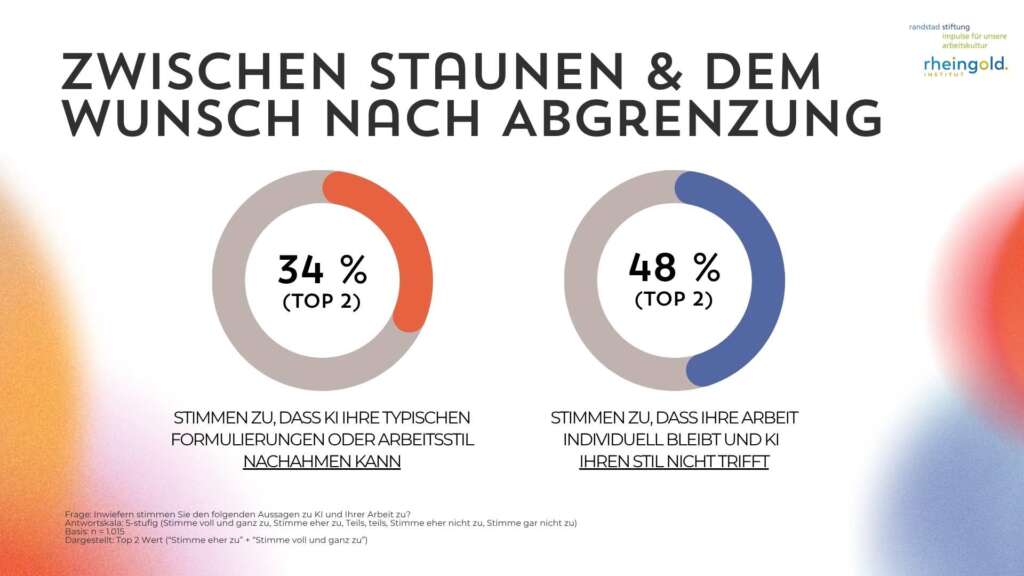
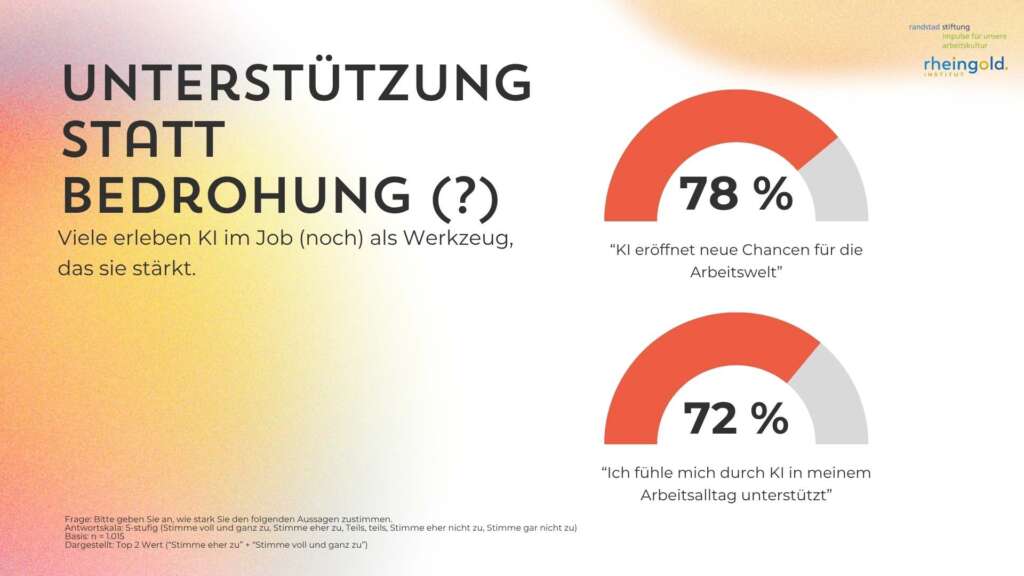
Artificial intelligence (AI) has arrived in many people's everyday lives at breakneck speed. 76% use it privately at least once a week, often playfully and experimentally - for travel planning, pictures or even as a virtual conversation partner or therapist. 83% state that they feel more fascinated than frightened by AI. However, a different picture emerges in the work context: While 78 percent see new opportunities for the world of work and 72 percent feel supported by AI, the in-depth interviews reveal mental stress.
AI as the beginning of a far-reaching disruption
The representative quantitative survey (n=1,015) and 32 two-hour in-depth rheingold interviews show: We are only at the beginning of a far-reaching mental disruption. AI is not only changing work processes, it is also calling identity and self-worth into question. In our culture, work is more than just gainful employment - it is an expression of one's own signature, creativity and expertise. This is precisely where AI touches a nerve: 33% (tend to) agree that AI can imitate their working style. 48 percent consider their work to be individual. Overall, people are experiencing growing competition from technology that imitates or even copies their skills.
Promise and reality: relief or densification?
The promises of AI are great. 59% confirm that tasks are completed much faster today with AI, 47% even experience that their creativity is inspired and their possibilities are expanded. 46% see their expectations fulfilled or exceeded because AI helps them to work faster and more efficiently.
However, these promises also arouse fears and mistrust, as the reality in some companies already looks different. Instead of relief, employees are experiencing consolidation, pressure to be efficient and acceleration. The hamster wheel is spinning faster, the world is racing even faster with an unknown destination. Young people are realizing that it is becoming more difficult to find a job and that they are competing with artificial intelligence. AI is thus becoming the catalyst of "turbo capitalism" for people: a promise of freedom that can turn into new dependencies or efficiency thinking.
The psychological dynamic: fascination, defense, repression
The study shows that the surface of curiosity and fascination is often accompanied by defensiveness. Although 54 percent say that the thought of AI taking over their work does not worry them. 55 percent also see no significant risks to their job. However, the in-depth interviews make it clear that this calmness is often a psychological defensive attitude. Many reassure themselves with the formula: "It won't affect me, other jobs are under threat, not mine."
This gives rise to typical ways of dealing with AI:
- declare their own skills to be "irreplaceable" (e.g. empathy, craftsmanship, social skills),
- Focusing on errors and deficits of the AI in order to validate itself,
- Secret use to better present your own performance
- Excessive use to increase one's own effectiveness,
- Humanization: AI as a friend, colleague or therapist.
26% use AI at work without their employer's knowledge, only 32% report clear guidelines. 34% say that there are no guidelines and that everyone handles its use differently. Only 28 percent have access to training.
At first glance, these manners seem harmless, but they can lead to a loss of trust, a lack of transparency and misunderstandings in teams. If employees use AI in secret or talk it down instead of talking openly about opportunities and concerns, there is no basis for a shared learning culture.
Uncertainty and a lack of guard rails
The figures make this clear: Most companies lack the structures to consciously integrate AI. Only 40% feel confident when it comes to data protection and compliance in dealing with AI, while 39% are confident that they can reliably recognize boundaries or hallucinations. For the majority, dealing with AI therefore remains a risk.
To make matters worse, managers are also insecure. They also oscillate between pressure to innovate and loss of control and run the risk of merging with the uncertainty of their teams. A lack of rules, a lack of vision and invisible error corridors exacerbate the situation.
"Companies must not view the introduction of AI solely as a technical task," emphasizes Johannes Dorn, Managing Director of the rheingold Institute. "We now need clear guidelines, transparent communication and spaces for open discussion. Only if fears are taken seriously and guidance is provided can AI be transformed from a factor of uncertainty into a shapable driver of a new work culture."
The sorcerer's apprentice as an image for the fear of losing control
"For many of our interviewees, AI feels like the story of the sorcerer's apprentice," says Leonie Allofs, Head of Studies at the rheingold Institute. "You summon spirits to relieve you of tedious work - and suddenly things get out of control. It is precisely this mixture of longing for relief and fear of losing control that characterizes the attitude of many employees towards AI."
A stress test for leadership and collaboration
Psychologically, AI is therefore a stress test for the world of work. It confronts companies not only with technical challenges, but also with cultural and emotional ones. 63% of those surveyed stated that their hopes outweigh their fears when dealing with AI, while for 20% their fears outweigh their hopes. However, as long as the repressed fear of replaceability is not addressed, it remains effective - and leads to tensions in teams, mistrust and insecure leadership.
"Especially in times of such profound disruption as AI, people need security, orientation and appreciation," emphasizes Hanna Daum, Managing Director of the randstad Foundation. "Only when employees feel that their skills remain important and that their contribution is recognized can they accept AI as a resource rather than a threat. This is exactly where the randstad Foundation comes in: Since 2005, we have been committed to making our work culture more human and understanding the motives that determine attitudes towards the future - far more than technology alone."
What companies should consider
It takes more than technical expertise to constructively integrate AI into the world of work. It is crucial:
- Clear guidelines and rules that create security and orientation
- Transparency in communication and goals to build trust
- Linking HR and data to manage the transformation process together in a meaningful way
- Participation that actively involves employees and allows for experimentation
- Education & training that combines technical, cultural and ethical dimensions
- Rethinking the creation of meaning: consciously emphasizing empathy, creativity and responsibility
- Promote courageous use so that AI is not only defended defensively, but can be actively shaped
Conclusion
The results show: AI is both a powerful promise and a psychological challenge for the world of work. While many employees experience fascination and support, the unspoken fear of substitutability remains effective. There is still a lack of clear rules, visions and cultural narratives that provide security.
If companies succeed in taking these fears seriously, facilitating open discussions and developing positive guiding principles, AI can be transformed from a source of uncertainty into a resource that can be shaped - and become the driving force behind a new work culture.
Representative population with a focus on AI and work
The population was mapped using a representative gross sample (by age, gender and region). Within this sample, we then looked specifically at those people who state that they occasionally use AI in their day-to-day work. The results are therefore representative of the group of AI users in everyday working life in Germany aged between 30 and 60 who work 20 hours or more - not of the population as a whole.
About the rheingold Institute :
rheingold conducts around 5,000 two-hour explorations a year on all areas of everyday life. We, around 45 permanent and 55 freelance employees, explore markets, media and culture. This has resulted in a unique wealth of experience on a wide variety of topics. From very intimate human phenomena to politics and everyday culture. rheingold thus has the most comprehensive, always up-to-date, qualitative knowledge about consumers worldwide.
About the ranstad Foundation:
Since 2005, the randstad foundation has been committed to our work culture with educational and career-related projects. It is committed to helping people and organizations recognize and understand changes in the world of learning and work and transform them into constructive actions in the long term. The randstad foundation wants to help make our work culture more humane and sensitize the public and society to the future of education and work.

Ismene Poulakos is a journalist and storytelling expert. At rheingold, she is responsible for all publishing activities such as PR studies and the rheingold webinars.
Phone: +49 221-466 828 0
E-mail: poulakos@rheingold-online.de