

A qualitative research survey by rheingold institut in cooperation with OutDoor by ISPO
Methodology
Psychologists from the Cologne-based rheingold institute were commissioned by OutDoor by ISPO to use in-depth psychological interviews and analyses to investigate the psychological core of outdoor.
Central findings
Especially in our overstimulated and overregulated society, the outdoor experience offers people a temporary exit into a pristine world where they can experience the majesty of nature without a digital filter.
Outdoor is based on a longing to return to our stone-age roots. The physical challenge in combination with the devotion to the mighty nature have a healing and meaningful effect and resemble religious traits.
The outdoor experience is not created selectively, but through a process of these three psychologically inseparable phases:
- Challenge: Get out of your comfort zone and into nature, prove yourself, discover new paths, and achieve a psychological opening, as if through shock ventilation. For this, one seeks the risk and the new.
- Proof and reward: Flow, but also fatigue, pain and dangers that need to be overcome. A campfire and a hearty dinner are a reward for the effort that has been overcome.
- Strengthened return: Each stage is a small hero's journey, but only the whole tour immunizes. The returnee is transformed, more mindful and with exciting stories in his luggage.
Outdoor motifs
The outdoor mindset:
Four basic mind-sets can be found that are based on a psychological motive structure. These mindsets allow a classification of brands and sports by means of a matrix. In this way, every brand and/or retailer can check its positioning approaches.
Framed escapism: the need for quiet and relaxed moments that are close to everyday life and flexible. One wants to experience nature and the pristine. However, always with a high urban and cultivating aspect that allows one to quickly have short outdoor moments. These can be small barbecue events in the park, but also a trip for a few days to the Eifel.
Classic love of nature: Here you want to get deep into nature and 'back to the roots', getting into your personal flow, which helps you to really switch off and fully absorb your surroundings. You become one with nature and feel part of something big and intangible, and without constant cell phone reception.
Urban Warrior: This constitution loads very strongly on the urge to fight and cope. In urban spaces, people like to stage themselves as heroes and fighters. However, with very high hedging mechanisms that offer one a lot of security despite all the strength. Good examples are the increasingly popular 'Tough Mudder' events, which offer total combat and challenge without any real danger.
Survival and adrenaline: Here we go into the depths of nature, directly into the confrontation with the elements. In contrast to the classic love of nature, you want to tame the impressive environment and prove your hard-learned skills. These heroic deeds are also very much on display again on social media channels.
Combining these motivational dimensions yields four constitutional clusters:
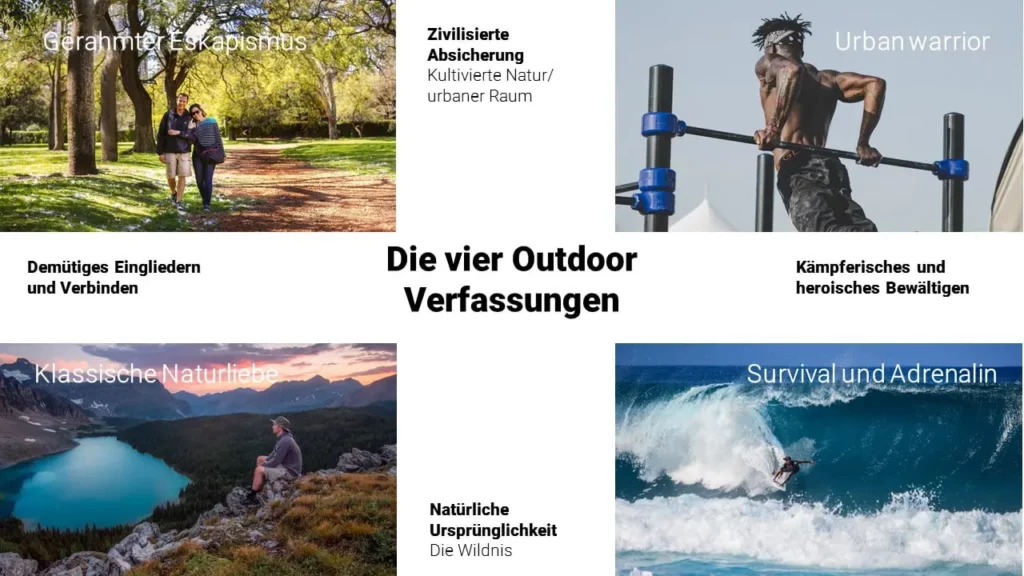
With an understanding of this matrix and the psychological outdoor process, retailers and brands can stage entirely new areas as outdoor experiences and sharpen their profile in terms of customer needs and perceptions. New customer groups are to be addressed especially in the area of "urban warrior" and "framed escapism".
Here you can download the white papers: