

Will to perfection drives people to mental exhaustion
The secret logic of depression
What does it mean to suffer from depressive moods in today's society, where we all have to work, function and deliver as if on a hamster wheel? How does depression manifest itself and how do those affected feel about it? What can relatives do and how do doctors and pharmacists deal with the symptoms of depressive mood?
Four million people in Germany suffer from depression, according to the German Depression Aid Foundation. In an extensive study initiated by Pascoe Naturmedizin, the Cologne-based rheingold institute took a depth-psychological approach to the subject of depression. The study showed that relatives as well as pharmacists and doctors are uncertain about how to deal with those affected. After all, depressives are not easy patients or customers. In addition, it was possible to fathom the inner logic of depression and thus make it easier to understand.
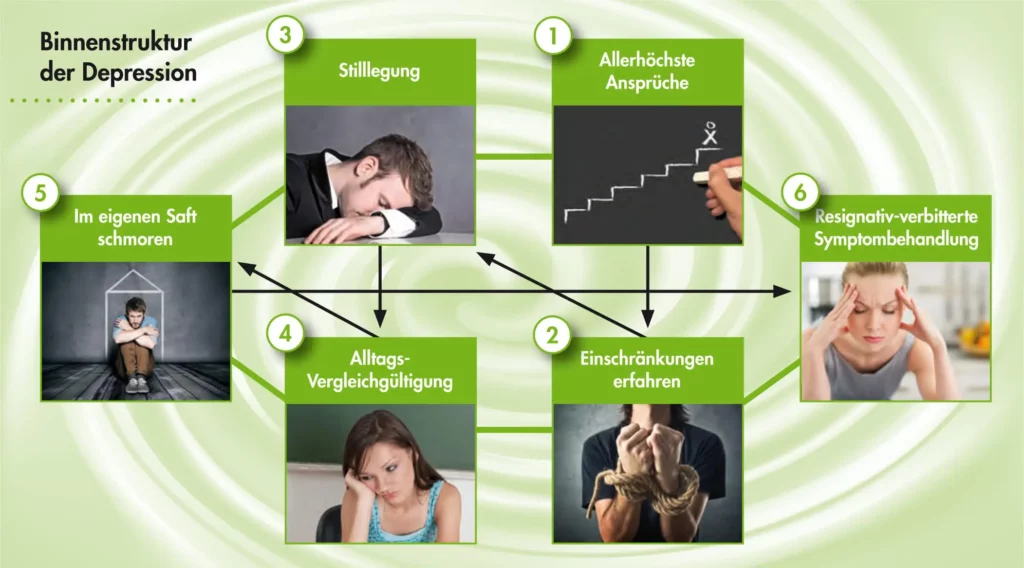
The inner structure of depression
All those affected by depressive moods reported no longer being able to participate in the happiness of this world. They feel "paralyzed," "sad" and overwhelmed in everyday life. They are under the impression that they can no longer cope with the social, family and professional demands and requirements placed on them. The cloak of silence is often placed over the depressive illnesses. It acts like a secret agreement of our culture, according to which 'depression' is named, but at the same time the real circumstances are stubbornly kept silent. The symptom of 'inner turmoil' or 'burnout', on the other hand, seems to be easier to convey to those affected. Burnout' in particular is an accepted symptom in our culture. Those who feel internally driven bear witness to being active and in motion.
The mere designation 'depression' or 'burnout' is only a label that does not do justice to the unique inner logic of mental illness. It is important to describe the individual traits that determine the internal structure of depression from the experience of those affected.
Highest demands
Affected persons try to meet all the tasks - both the demands on themselves and those on daily life. These demands act as a restless driver. Often, they feel solely responsible for everything - for professional success, family needs, organizing everyday family life and caring for children or relatives. In the interviews, too, it was astonishing that those affected did not seem depressed or at a standstill at all, but agile and full of energy. Here, too, the high demands that the people affected made of themselves were reflected.
Experience limitations
Those affected experience that aspirations cannot always be realized. They suffer from the discrepancy between their ideal image on the one hand and feasible reality on the other. All people experience this difference between their own dreams and the 'normative power of the factual'. However, the experienced limitation by life and everyday conditions throws those affected completely off track: A situationally experienced limitation of not being able to do something or making a mistake leads to a feeling of having failed all along the line.
Decommissioning
If those affected do not achieve their aspirations, this by no means leads to their ambitions being revised, mourned or angrily rebelled against. An active confrontation with the situation does not take place; instead, people withdraw and literally lie down quietly. The very process of grieving, which is so important but also painful, does not take place. Grieving enables people to say goodbye and to part irretrievably with what they have come to love. Since this painful letting go ultimately does not take place, one's own aspirations are not abandoned either, but frozen and preserved in depression.

Everyday Comparisons
The immobilization is stabilized by unconsciously repelling or invalidating all impulses that could stimulate activity. Tasks and stimuli of everyday life all receive the same validity, that is, there is no more prioritizing of activities and life issues. Often they feel that the real problems remain unsolved. However, the persistent symptoms also give them the right to be treated gently and handled with kid gloves by their environment.
Stewing in your own juice
To the outside world, those affected appear lethargic and as if paralyzed. This also demands a lot of tolerance from the relatives. However, the affected persons themselves do not experience the shutdown as a retreat or time-out; they only calm down externally and run hot internally. The inner drive prevents those affected from catching their breath and robs them of sleep. They have the feeling that they are not getting anywhere, despite constantly dealing with the same issue. This 'stewing in one's own juice' is also a gigantic self-intensification: one sees only oneself and one's own misery. One is incredibly close to oneself in an undivided way.
Resignative-bitter symptom treatment
Those affected end up in a resigned and bitter symptom treatment. They resign themselves to the fact that they cannot get out of their depression, out of their narrowness, and merely try to dim down the symptoms or get them under control. They treat themselves, not to get rid of the disease, but to get control over the symptoms. Often, however, sufferers feel that the real problems remain unresolved. At the same time, the symptoms are also proof or a bitter accusation against themselves and the world that they have experienced unjust restrictions and therefore cannot fulfill their high expectations.
Forms of self-treatment
In the run-up to the depressive illness, but also during it, those affected have developed a whole range of forms of self-treatment. They try to distract themselves with the help of various activities, to get their minds off things and seek contact with nature and the calming rhythms of the seasons. They take time for self-pampering rituals such as hot baths or wellness treatments. They also often try to channel their inner turmoil and doubt by compensating for performance and escaping into a mindless bustle. In most cases, however, sufferers shift the treatment of depression to the treatment of physical symptoms. In doing so, however, they keep the depression alive.
Dealing with affected persons
Treating depressed patients requires a sensitive approach on the part of physicians and pharmacists, since they are not just treating an illness or the symptoms, but the whole person, who is very sensitive and easily offended. This requires a balancing act from physicians and pharmacists. On the one hand, they should be listeners and confidants, but on the other hand, they should not get too close to the patient.
Demanding patients for doctors
It is striking how difficult many physicians find it to deal with depressed patients. They experience the patients as borderline and demanding. Conversations often last too long and are difficult to manage. Physicians often find the demands of depressed patients to be an imposition. These unpredictable factors disrupt their practice workflow. Depressed patients cost them a lot of time and nerves. Doctors also feel blackmailed by patients threatening suicide.
The general unease - also that of our culture - becomes clear in the physicians. Doctors feel that in dealing with depressed patients, they are getting into something that is deeply scary to them and that they cannot get a direct handle on. This causes cracks in the image of the healing and miracle-performing doctor. Psychologically, physicians find themselves in a situation almost similar to that of their depressed patients. They, too, experience fundamental limitations in their treatment.
Difficult customers for pharmacists
Dealing with depressed customers is also difficult for pharmacists. They have to decode and interpret the customer's complaints correctly. In most cases, customers do not dare to talk about their depression. They then report 'inner turmoil' or physical symptoms that are easier to talk about than their depression.
If customers open up, pharmacists must provide therapeutic help. However, this requires time, empathy and competence. On the one hand, some pharmacists see an opportunity here to step into a trusting, counseling and treating position, but on the other hand, many also feel uncomfortable and sometimes overwhelmed here.
Eight recommendations for relatives
01
The risk of depressive illness increases when people no longer find time for reflection and self-reflection in their hectic daily lives. Relatives should advise those affected to prophylactically build stretching gaps into their own daily lives, e.g., extended breaks, unscheduled days, moments of boredom and idleness.
02
When dealing with very sensitive patients, it is important to take them seriously in their suffering on the one hand, but also to help them to lower and revise personal demands on the other.
03
Relatives or physicians should support them in finding a more open and offensive way of dealing with annoyances: actively fighting back, not simply accepting losses or defeats, but mourning them.
04
Relatives often experience it as stressful that patients constantly revolve around themselves. It is helpful if they move along with the patients and empathically follow their gyrations, but they also carefully help them to open their eyes to other things.
05
With herbal medicines, those affected can effectively alleviate initial signs such as restlessness and sleep disturbances without side effects.
06
Quick treatment successes are not to be expected in view of the mental shutdown. The demand for speed burdens the treatment and often produces new experiences of restriction. It is important for relatives and physicians to agree on small steps and to develop a treatment perspective with the patient.
07
The self-destructive 'all-or-nothing principle' can only be dissolved if a process of reflection begins with the patient as to what is really important and from which demands or tasks one wants to say goodbye in the short and long term.
08
In the course of the (self-)treatment process, it also becomes important to gradually assume or transfer responsibility. The message: The will to perfection is a spectre that drives people to exhaustion. Even in our modern times, personal development is not possible without personal guilt and limitation.