

Family, friends, freedom: For Germans, real estate is far more than an investment
New edition of the Interhyp housing dream study shows that 76 percent would like to have their own property /
Housing dreams remain realistic and pragmatic even in low interest rates
"The two-stage study shows that, despite increased purchase prices and value growth, real estate is not an investment property for the majority. Rather, the qualitative part of the study in particular revealed the Germans' strong emotional attachment to home, which was confirmed quantitatively," explains Mirjam Mohr, Member of the Management Board of Interhyp AG at the presentation of the study results in Munich. What moves humans approximately around their own at home? How do they live and what wishes, fears and needs do they have in this regard? In order to better understand these aspects, Interhyp AG has been conducting the dream home study since 2011. "At Interhyp, we have been accompanying people on their way to their own home for 18 years and are the market leader with a brokered mortgage volume of almost 20 billion euros in 2017," says Mohr. According to her, the study paints a detailed picture of the wishes, experiences and expectations with regard to residential and rental property.
Down to earth living dreams
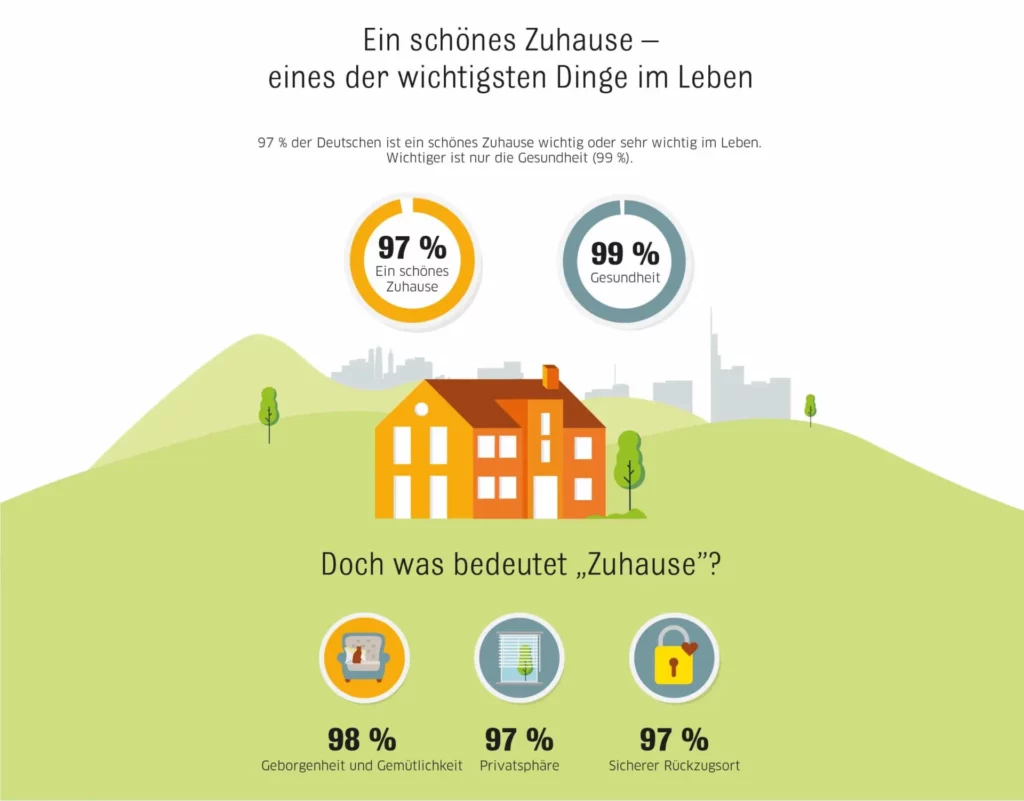
The survey shows how solid and unagitated Germans' housing dreams are. "The topic of housing is on people's minds. At the same time, it has been revealed how sober and factual the dreams turn out to be. People always have in mind what is realistic for themselves," explains Mohr. There are hardly any luxury fantasies. Instead, the dream home should be bright, practical, tidy and down-to-earth. "For those surveyed, the home is an extremely important place of retreat, where they recharge their batteries and enjoy their privacy. Almost everyone associates the home with a sense of security and comfort. At the same time, it is a social place that connects people with friends and family. That's why location and surroundings are so important - not only in real estate appraisals by banks, but also in individual valuations," explains Mohr.
How Germans live: More than 100 square meters in the city
According to the study, people are very satisfied with their living situation. According to the study, 63 percent live in an apartment building with an average of 106 square meters and four rooms. 60 percent live in a small or large city, 25 percent in the countryside or village, 15 percent in the outskirts of a city. "Because for the majority it should not be the luxury penthouse, but a realistic home, people feel comfortable," comments Mohr.
Home ownership and housing happiness
According to Interhyp, the correlation between home ownership and happiness is interesting. According to the study, 76 percent would like to own their own property. Regardless of real estate prices, Germans no longer want to rent. They hope that home ownership will give them more independence, more scope for design, freedom from rent and security in old age. In addition, their own four walls make them happy. Those who have already bought their own home are very happy with it (91 percent) because, among other things, they have more space than tenants. At the same time, many of those who have not yet bought worry about a possibly too high financial burden due to the loan and fear that they will not be able to find a suitable, affordable property - a concern that, according to the study, actually only very rarely materialized among property owners.
Renaissance of the family and closeness to nature
Two trends are apparent from the qualitative interviews: "People long for nature, freedom and tranquility. In the countryside, they feel more integrated into the community. They want to get out of the big city, away from the bad air and overpriced real estate," Mohr quotes from the interviews. These tendencies were confirmed quantitatively in the panels: near-natural and quiet residential areas are in vogue, the big city is not at all as popular as one might assume. Fifty-six percent of respondents even describe themselves as being bothered by noise. The second trend points toward the family. In the qualitative interviews, the participants conspicuously often wanted to live near their family and close friends, and some even accepted compromises for this - such as a further commute to work. These statements were confirmed quantitatively. For 53 percent, proximity to family is very important. In 2016, only 36 percent said that. 84 percent say being close to family gives them a sense of stability, rootedness and home.
To the Interhyp dream home study
Interhyp AG has been conducting the dream home study since 2011. For the new edition in 2018, Interhyp, together with rheingold institut, expanded the scope of the study and developed a two-stage study design. The first step was 20 qualitative psychological in-depth interviews. In the second step, the most important findings of the interviews were converted into quantitative questionnaires and 2,100 people were surveyed in March and April in a nationwide and representative online panel. This made it possible to capture all the respondents' needs and wishes relating to their own homes. You can find the most important results at a glance at wohntraumstudie.interhyp.de.

Uwe Hambrock, graduate psychologist, has been working successfully for rheingold institut since 2007. As senior project manager and part of the quantitative research team, his main areas of expertise are food, retail and financial services.
Phone: +49 221-466 828 0
E-mail: hambrock@rheingold-online.de